

Quick Summary:
Meta Ads AI connectors allow advertisers to connect ad accounts directly with AI assistants through secure integrations, enabling campaign analysis, reporting, optimization, and management using natural language. Instead of navigating dashboards manually, marketers can now interact with advertising data conversationally, accelerating decision-making, reducing repetitive work, and fundamentally changing how media buying operates.
For years, media buyers have accepted a frustrating reality: valuable campaign insights often sit buried behind layers of dashboards, filters, attribution windows, and reporting tabs. The challenge was never a lack of data. The challenge was speed.
Finding performance issues, identifying winning audiences, adjusting budgets, and generating reports often required hours of manual work. By the time insights surfaced, opportunities had already moved on.
That workflow is now changing rapidly. The arrival of Meta Ads AI connectors signals a shift from dashboard-driven advertising toward conversation-driven campaign management, where AI assistants can directly interact with advertising accounts and respond to complex requests in seconds.
The Shift Away From Traditional Ads Management
Most advertising platforms were designed around interfaces. Marketers clicked through menus, selected filters, exported reports, and manually interpreted performance data.
AI connectors introduce a different model.
Instead of searching for metrics, advertisers can ask questions naturally:
- Which campaigns are losing efficiency?
- What audience segments are improving conversion rates?
- Which ad sets need budget adjustments?
- What creative patterns are generating stronger engagement?
The system retrieves live campaign information and provides direct responses based on account data. This transformation is one reason Meta Ads AI connectors are attracting significant attention across the advertising industry.
What Makes These Connectors Different
Many marketers assume this is simply another reporting tool.
The reality is more significant.
These integrations create authenticated connections between AI assistants and advertising accounts, allowing access to campaign performance, audience signals, diagnostics, and account management capabilities through natural language requests.
The key difference is context.
Instead of reviewing isolated metrics, AI can interpret relationships between campaigns, audiences, budgets, and performance trends simultaneously.
That level of analysis previously required experienced analysts spending substantial time inside reporting environments.
Why Media Buying Is Becoming More Conversational
A major gap in most discussions around AI advertising tools is the psychological shift happening among marketers.
The future is not merely automation.
The future is conversational decision-making.
When advertisers can ask detailed questions and receive contextual recommendations instantly, campaign management becomes less dependent on navigating interfaces and more dependent on strategic thinking.
This evolution is where Meta Ads AI connectors create long-term impact. They reduce operational friction while allowing marketers to focus on creative direction, audience psychology, and building growth strategies that survive platform changes, instead of repetitive platform tasks.
Faster Campaign Analysis Without Report Fatigue
One overlooked issue in media buying is reporting exhaustion.
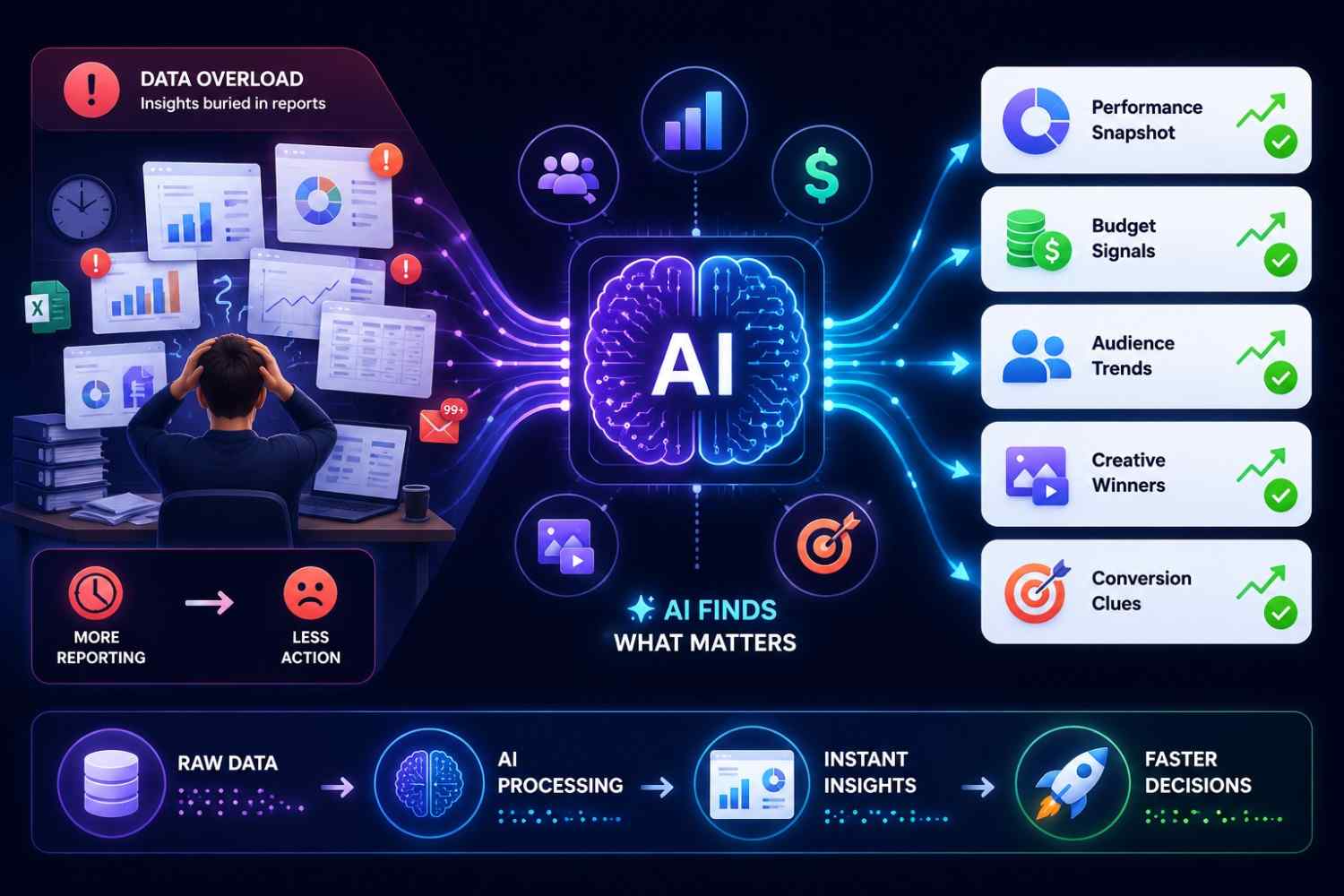
Large accounts generate overwhelming amounts of performance data. Teams frequently spend more time preparing reports than acting on them.
AI-powered analysis changes that dynamic.
Instead of reviewing dozens of metrics manually, marketers can receive:
- Performance summaries
- Budget recommendations
- Audience trend analysis
- Creative performance breakdowns
- Conversion pattern insights
This is where Meta Ads AI services begin delivering operational value beyond simple automation. They shorten the path between data collection and actionable decisions.
The Emerging Role of Predictive Optimization
Media buying has traditionally been reactive.
Campaigns launch. Data accumulates. Optimizations happen later.
AI-assisted systems increasingly move toward predictive behavior.
By analyzing patterns across campaigns, audience engagement, conversion activity, and historical performance, AI can identify potential issues before they become expensive problems.
This capability gives Meta Ads AI connectors a strategic advantage because they are evolving beyond reporting into intelligent campaign guidance.
What Most Articles Are Missing
Much of the online discussion focuses on setup processes and technical integrations.
The deeper transformation is organizational.
Advertising teams are beginning to operate differently.
Instead of assigning analysts to generate reports, marketers can ask AI for instant performance explanations. Instead of waiting for weekly reviews, insights become available continuously.
This changes:
- Team workflows
- Campaign response times
- Resource allocation
- Decision-making speed
As adoption expands, Meta Ads AI connectors may reshape agency structures and in-house marketing operations just as significantly as they reshape campaign management itself.
The Balance Between Automation and Human Judgment
Despite growing excitement, AI is not replacing media buyers.
The strongest results still depend on human interpretation.
AI can identify trends, recommend adjustments, and surface opportunities. It cannot fully understand brand positioning, emotional creative direction, market nuances, or long-term business goals.
This is why Meta Ads AI services work best when paired with strategic oversight rather than full autonomy.
The winning approach combines machine speed with human judgment.
Where the Industry Is Headed Next
Advertising platforms are increasingly moving toward AI-native workflows. Instead of opening dashboards first, marketers may soon begin their day by asking AI assistants for account summaries, performance alerts, creative recommendations, and budget opportunities.
As these systems become more sophisticated, Meta Ads AI connectors will likely evolve from campaign assistants into operational partners capable of handling large portions of campaign management while keeping human marketers focused on growth strategy.