Quick Answer:
Recovering from the 2026 Google Core Update requires more than quick SEO fixes. Websites that lost rankings are typically seeing issues connected to weak E-E-A-T signals, thin AI-generated content, outdated information, poor user experience, or low-value pages created primarily for search engines instead of users. The most effective recovery strategies involve improving content depth, strengthening trust and expertise signals, updating old pages, cleaning toxic backlinks, and aligning content more closely with user intent. Recovery often takes several weeks or months, especially after broad core updates.
Few things create more panic for website owners than waking up to a sudden traffic collapse.
Pages that ranked steadily for years suddenly disappear from search results. Leads slow down. Revenue drops. Rankings fluctuate daily without explanation. Then the realization hits: another major Google Core Update has rolled out.
The March 2026 update has been especially disruptive because it appears to evaluate websites more aggressively across multiple quality signals at once. Many websites did not simply lose rankings for one page or keyword. Entire content sections lost visibility simultaneously.
That shift is forcing businesses to rethink what sustainable SEO actually looks like.
The good news is that it is still possible to recover from a Google Algorithm Update in 2026 without resorting to panic-driven changes that often make things worse.
The 2026 Core Update Focuses More Deeply on Content Quality
Google’s recent updates are no longer targeting isolated SEO tricks alone.
The March 2026 Core Update appears to evaluate:
- Content usefulness
- Author credibility
- User satisfaction
- Originality
- Real-world experience
- Trust signals
- Content freshness
- Site-wide quality consistency
Websites filled with generic, repetitive, or heavily automated content are seeing some of the biggest ranking declines. Pages created primarily to rank for keywords instead of helping users are struggling far more than before.
This explains why many sites publishing large amounts of lightly edited AI content experienced severe visibility drops during the rollout.
Do Not Make Immediate Panic Changes
One of the biggest mistakes website owners make after a ranking drop is reacting too quickly.
Core updates often create temporary volatility while Google finishes processing new ranking signals. Rankings may fluctuate significantly for several weeks before stabilizing.
Businesses trying to recover from a Google Algorithm Update in 2026 should first wait until the rollout fully completes before making aggressive structural changes.
Premature actions like:
- Deleting large sections of content
- Mass redirecting pages
- Changing URLs unnecessarily
- Over-optimizing keywords
- Buying backlinks quickly
can create additional ranking instability instead of helping recovery.
A measured audit always works better than emotional SEO decisions.
Thin Content Is Being Filtered More Aggressively
One major pattern across the 2026 update involves low-value informational pages.
Content is struggling when it:
- Repeats information already everywhere online
- Lacks firsthand expertise
- Uses vague AI phrasing
- Fails to answer user intent clearly
- Prioritizes keywords over clarity
- Contains outdated information
Google now appears significantly better at distinguishing between content written to genuinely help readers versus content produced mainly for publishing volume.
To recover from a Google Algorithm Update in 2026, websites need to evaluate whether every indexed page truly deserves visibility.
Sometimes improving rankings requires publishing less content, not more.
E-E-A-T Has Become Much More Important
Experience, Expertise, Authoritativeness, and Trustworthiness now influence rankings more visibly than many SEO strategies people relied on previously.
Websites lacking strong credibility signals are increasingly vulnerable during core updates.
Important trust indicators now include:
- Detailed author bios
- Clear business information
- Updated contact pages
- Transparent editorial standards
- Original insights and experience
- Accurate sourcing
- Consistent topical authority
Google appears to favor websites demonstrating real-world familiarity with subjects rather than broad, generalized content farms.
This is especially noticeable across:
- Health
- Finance
- Technology
- Legal
- Marketing
and other high-trust industries.
AI Content Is Not the Problem — Generic Content Is
One misunderstanding after the 2026 update is assuming Google penalizes AI-generated content automatically.
That is not entirely accurate.
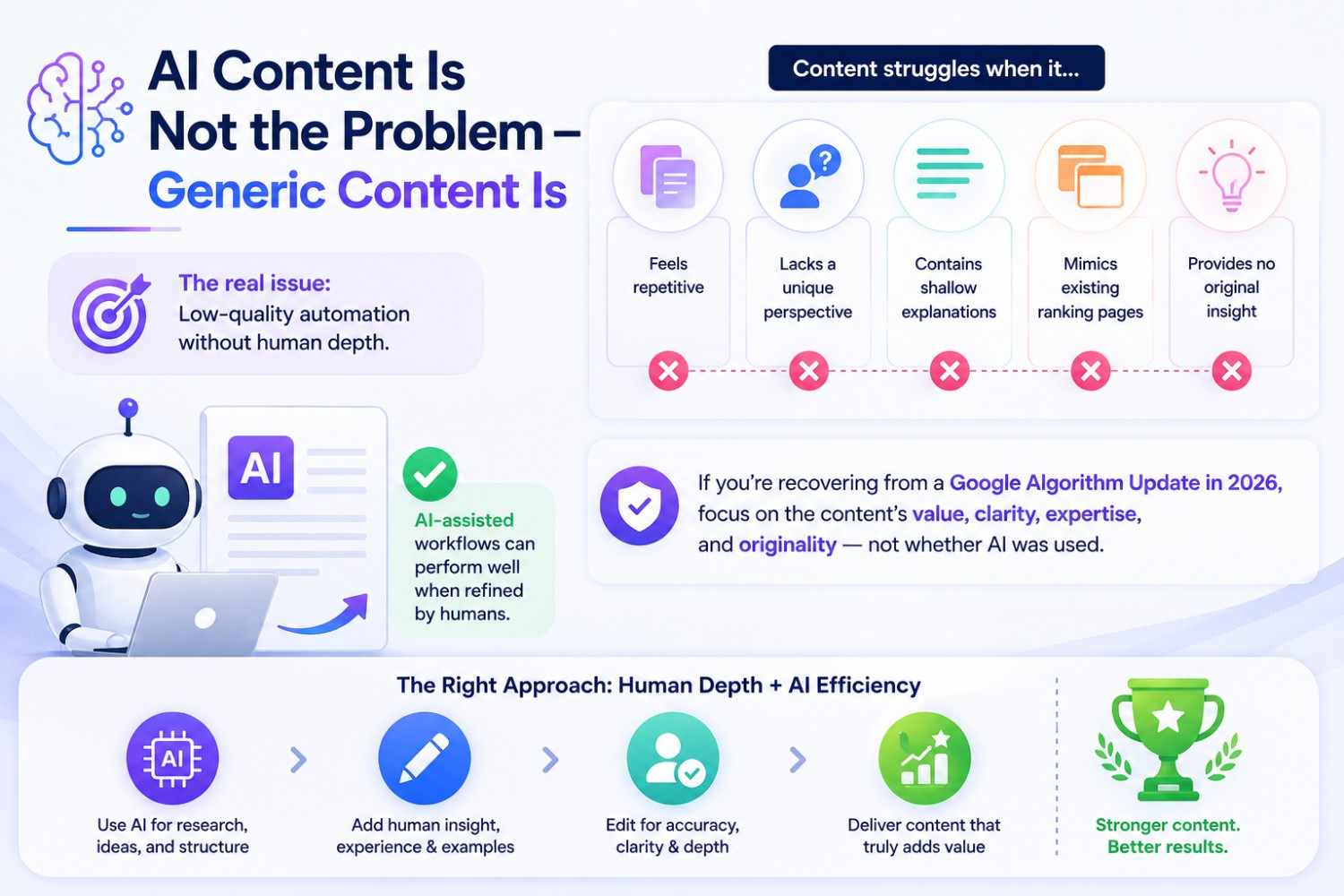
The problem is low-quality automation without human depth.
Content tends to struggle when it:
- Feels repetitive
- Lacks a unique perspective
- Contains shallow explanations
- Mimics existing ranking pages
- Provides no original insight
Businesses trying to recover from a Google Algorithm Update in 2026 should focus less on whether AI was used and more on whether the final content demonstrates genuine value, clarity, expertise, and originality.
AI-assisted workflows can still perform well when combined with strong editing, experience-based insight, and human refinement.
User Experience Is Quietly Influencing Rankings More
Technical SEO alone no longer guarantees strong visibility, but poor user experience now creates bigger ranking disadvantages than before.
Sites commonly affected by the update often struggle with:
- Slow mobile performance
- Excessive ads
- Poor navigation
- Weak internal linking
- Cluttered layouts
- Thin category pages
- Confusing site architecture
Google increasingly evaluates how satisfying pages feel for real users after the click, not only how well they match keywords before it.
This means websites aiming to recover from a Google Algorithm Update in 2026 should audit actual visitor experience rather than focusing only on metadata and backlinks.
Updating Existing Content Works Better Than Constant Publishing
Many websites respond to ranking drops by publishing more articles rapidly.
That approach often fails now.
The 2026 update strongly favors freshness, depth, and accuracy within existing content. Updating older pages with:
- Better structure
- More current information
- Stronger expertise signals
- Improved readability
- Enhanced search intent alignment
often produces better recovery outcomes than creating dozens of new posts.
Google increasingly appears to reward maintained content ecosystems rather than abandoned archives filled with outdated pages.
Backlink Quality Still Matters
Although content quality dominates most recovery discussions, backlink profiles still influence recovery speed.
Low-quality links from:
- Spam directories
- Irrelevant guest posts
- Automated networks
- Link farms
- Expired domains
can weaken trust signals significantly.
Businesses trying to recover from a Google Algorithm Update in 2026 should review backlink profiles carefully instead of continuing outdated link-building tactics that no longer provide sustainable authority.
Relevant, editorially earned links remain far stronger than high-volume manipulative backlink strategies.
Recovery Usually Takes Longer Than People Expect
Many website owners expect immediate improvement after making SEO changes.
Core update recovery rarely works that way.
Google often reassesses quality changes gradually over weeks or months, especially after broad updates affecting trust, expertise, and content quality signals sitewide.
Some websites recover partially within a few weeks. Others improve more noticeably after future core updates reevaluate the site.
Consistency matters more than short-term ranking spikes.
Building a More Stable SEO Foundation for the Future
The March 2026 Core Update reinforced something many businesses resisted for years: search visibility is becoming increasingly tied to genuine quality, expertise, and user satisfaction rather than isolated SEO tricks. Websites relying on thin publishing strategies, mass-produced content, or weak trust signals are becoming far more vulnerable during major algorithm shifts.
To recover from a Google Algorithm Update in 2026, businesses need to think beyond rankings alone and focus on building websites users genuinely trust, engage with, and return to over time. The strongest recovery strategies are no longer about gaming algorithms. They are about aligning with what search engines increasingly reward naturally: depth, usefulness, credibility, and experience-driven content.
Spiderweb Technologies helps businesses navigate algorithm recovery with a more strategic approach focused on technical performance, E-E-A-T optimization, content quality improvement, and long-term SEO stability designed to withstand future Google updates more effectively.